
What Is a Tandoor Oven and Why Do Indian Restaurants Use Them?
Most Indian restaurant menus have a “tandoor” section. Most diners have no real idea what that means. Here’s a plain-language explanation of what a tandoor oven actually is, why restaurants bother running one, and what it does to food that nothing else can.
You’ve probably noticed the word “tandoor” or “tandoori” all over Indian restaurant menus. Tandoori chicken. Tandoori naan. Tandoori vegetables. Tandoor mixed grill. It shows up as a category, a cooking descriptor, an adjective stuck onto dishes that somehow taste different from their non-tandoori versions. But what does it actually mean? What is a tandoor oven, how does it work, and why do Indian restaurants keep investing in them when a conventional oven would be cheaper and a lot easier to run?
The short answer: a tandoor is a clay oven that runs at temperatures a conventional oven simply can’t reach, using a form of radiant heat that produces food a conventional oven can’t produce either. The longer answer is more interesting.
It’s worth understanding the tandoor in some detail, because it clears up something most Indian restaurant regulars run into without ever getting a satisfying explanation — why food from the tandoor section specifically tastes the way it does, and why every attempt to recreate it at home falls a little short. It’s not the recipe. It’s not the spice blend. It’s not even the chef’s technique, though technique certainly matters once you’re operating the oven. It’s the equipment. And that equipment is a clay cylinder that’s been used in essentially the same form for at least five thousand years.
What a Tandoor Oven Is
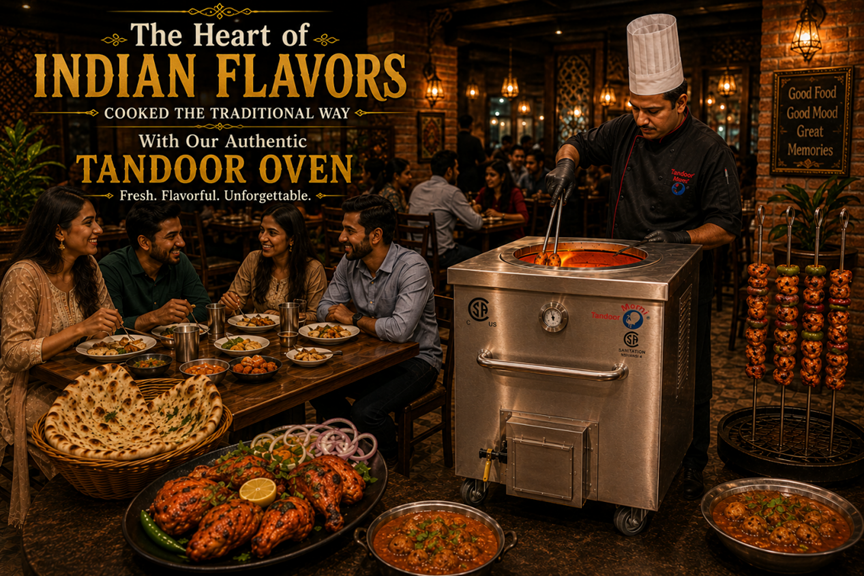
A tandoor is a cylindrical oven made of clay. The design itself is ancient — versions of it turn up at archaeological sites dating back to at least 3000 BCE in the Indus Valley. It’s been in continuous use across South Asia, the Middle East, and Central Asia ever since, which is a pretty reasonable sign that it works.
The basic construction is simple enough: a clay cylinder, wider at the base than at the top, with a narrow opening up top where food goes in and smoke comes out. The inside is smooth fired clay. The heat source — charcoal or gas — sits at the base. The clay walls soak up that heat, hold onto it, and radiate it back into the chamber from every side. Modern restaurant tandoors follow the same basic principles as the traditional design, just with gas burner systems, stainless steel exterior housing, and whatever certification a commercial kitchen appliance needs to meet in the US and Canada added on top.
How a Tandoor Oven Works
A tandoor’s working temperature sits between 800 and 900°F — roughly double what a conventional home or commercial oven can reach. That heat doesn’t come from the gas burner alone; it comes from the clay walls absorbing heat over time and radiating it back into the chamber.
That’s called radiant heat, and it behaves very differently from the convected heat of a regular oven. Convected heat travels through air — a fan circulates hot air around the food, gradually transferring heat to the surface. Radiant heat transfers energy directly, with no air in between. Food sitting inside a tandoor is getting hit with radiant heat from a 900-degree clay surface on every side at once, not just warm air drifting past it. The practical result is much faster, more intense cooking that produces specific surface effects — blistering, charring, caramelization — that convected heat just can’t replicate.
The reason a tandoor is made from clay, rather than metal or high-temperature ceramic, comes down to the physics involved. Metal is a great conductor, which means it transfers heat fast but also loses it fast. A metal oven preheated to 900 degrees would cool off noticeably the second food went inside. Clay is the opposite — a poor conductor but an excellent thermal mass. It absorbs heat slowly, holds it across its whole volume, and releases it gradually and evenly. Open a tandoor at full temperature, lower food inside, and the clay walls barely cool at all. They keep radiating heat at 900 degrees through the whole cooking process, holding the exact conditions responsible for tandoor cooking’s signature surface effects. The clay isn’t just a container here — it’s the active part of the whole system, doing something no metal or ceramic alternative can match.
What a Tandoor Does to Different Foods
For bread — naan, roti, kulcha — the tandoor works through contact cooking. Shaped dough gets slapped directly against the inner clay wall, sticks there, and cooks in direct contact with fired clay at around 900 degrees. The moisture inside the dough flashes into steam almost immediately, pushing outward through the surface and creating that signature blistered texture. The edges char. The whole thing’s done in under two minutes. It’s a completely different process from baking bread in a regular oven, which cooks more slowly through circulating hot air.
For meat — tandoori chicken, seekh kebab, boti kebab, tikka — the tandoor works through vertical roasting. Skewers loaded with marinated meat get lowered in and hung vertically inside the chamber, cooking from all sides at once in the radiant heat. The vertical position matters a lot here: fat renders out of the meat and drips down to the base rather than pooling around it and being reabsorbed. That’s exactly why tandoori chicken has that dry, intensely flavored exterior — the fat’s simply out of the picture.
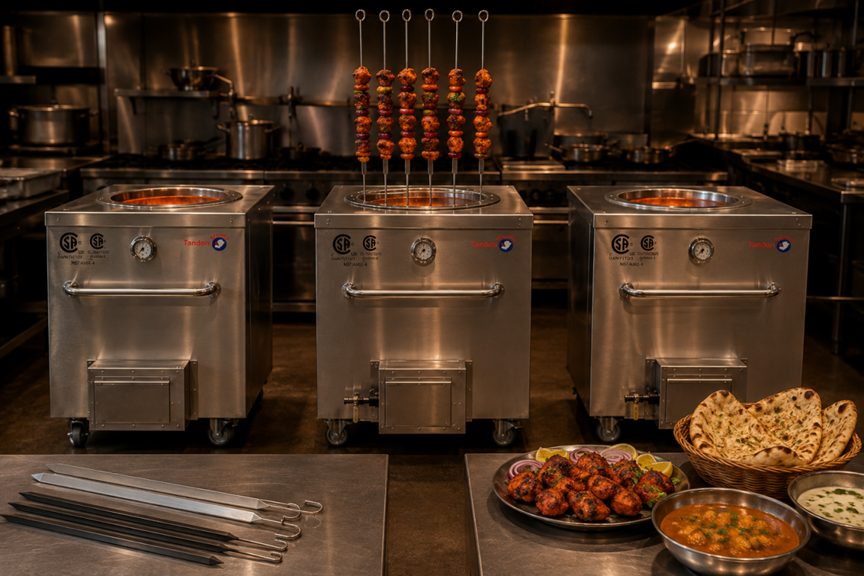
The skewers used for this — the Tandoor Skewers every Indian restaurant kitchen keeps on hand — come in different widths depending on the job. Flat skewers are used for seekh kebab, where minced meat needs something to grip onto. Thinner round skewers handle tikka and boti, where cubed meat gets threaded and needs to cook evenly without spinning.
Knowing which dish needs which skewer type gets at something important about the whole system: a tandoor isn’t a general-purpose oven adapted for whatever you throw at it — it’s a system built around specific dishes. The tandoor section on an Indian restaurant menu is exactly the section the oven was designed to produce. Seekh kebab needs a flat skewer because minced meat needs a gripping surface to hold its shape while the outside sets; without one, the meat just slides off or falls apart. Tikka needs a thin round skewer because cubed meat has to sit apart from other pieces so radiant heat can reach every surface evenly. Naan needs direct contact with the clay wall itself, because the steam pressure that creates blistering only happens when dough touches a high-temperature solid surface directly. Every piece of the system — the clay, the shape of the chamber, the skewer types, where food sits inside the oven — was worked out around the specific needs of these dishes. The dishes and the oven basically evolved together.
Why Indian Restaurants Use Them
The straightforward answer is that a Tandoori Oven produces food that can’t be made any other way. That specific combination — clay radiant heat, extreme temperature, wall-contact bread cooking, vertical fat-draining meat roasting — produces results nothing else can match. A restaurant that wants to serve genuine tandoori chicken has to run a tandoor. A restaurant that wants real naan has to run a tandoor. No griddle, no baking tray, no pizza oven gets you there.
The investment in a commercial tandoor is real — the equipment itself, installation, certification, ongoing maintenance. Restaurants take it on because what comes out of the oven is worth it to their customers. The tandoor section on an Indian restaurant menu isn’t a gimmick or a specialty add-on. It’s the kitchen’s primary cooking system, the thing everything else is built around.
For diners using a restaurant discovery site to decide where to eat, a genuine tandoor section is honestly one of the more reliable quality signals out there. A restaurant that’s invested in certified commercial tandoor equipment — NSF/ANSI 4 for US venues, CSA Z83.11 for Canadian commercial kitchens — has made a commitment to authentic cooking that’s both expensive and visible in the food itself. Those certification requirements aren’t a rubber stamp, either — independent lab testing, detailed compliance paperwork, ongoing maintenance standards. Restaurants that clear that bar do it because they actually take their tandoor cooking seriously. And the food shows it, in ways you can pick up on almost immediately.
Now that you know what it is, you’ll probably look at an Indian restaurant menu a little differently. The tandoor section is the heart of the kitchen. The dishes that come out of it require the most specific, hardest-to-replicate equipment on the premises. More often than not, those are the dishes actually worth ordering.
One practical tip for next time you’re at an Indian restaurant: if the kitchen is visible from the dining room, take a look for the tandoor, or just ask your server if it’s in active use. The question tells you something, and the answer tells you more. A restaurant where the tandoor’s been running since the kitchen opened — where the clay’s already up to temperature before the first table sits down — is a restaurant where the bread and marinated meats will be exactly what they should be. A restaurant where the tandoor is a fixture on the menu but an afterthought in the kitchen is one where you’ll probably get a decent approximation of the real thing. The difference is the clay. Now you know what to look for.